Ancient Roots
More than a sport, a sacred ritual.
Professional Sumo is a 1,500-year-old Shinto ritual and the national sport of Japan, where every match serves as a religious ceremony to entertain the Kami (gods) and ensure a bountiful harvest.
The canopy above the ring mimics the roof of a Shinto shrine. The salt tossed before a bout is for purification, driving away evil spirits. Even the wrestler's stomp (Shiko) is designed to crush demons hiding in the earth.
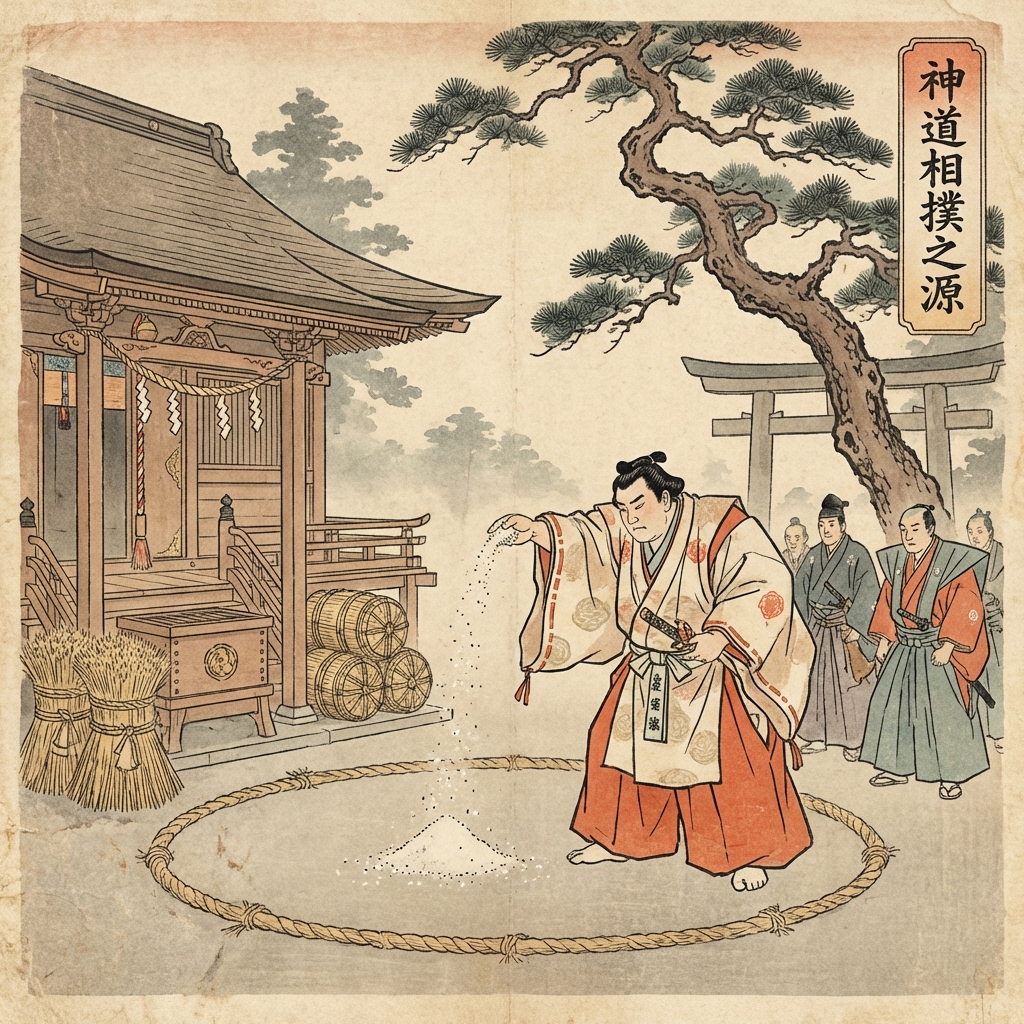
The sacred Dohyo and the presence of the Kami.
Dohyo
土俵The sacred ring where bouts take place. Made of specific clay and rice straw bales (tawara), it represents a purified space. The roof above (tsuriyane) resembles a Shinto shrine roof.
Purification Rituals
清めの儀式Before a bout, wrestlers toss salt (kiyome-jio) to purify the ring. They also stomp the ground (shiko) to drive away evil spirits and rinse their mouths with water (chikara-mizu).
Gyoji
行司The referee. Clad in elaborate silk outfits based on medieval court drass, they carry a gunbai (war fan) to signal the winner. They also carry a dagger, symbolizing their willingness to commit seppuku if they make a grave error (symbolically).